Drought
One of Malawi’s most serious and costly climate hazards, mapped across the country by likelihood, impact and overall risk.
Likelihood, impact & risk
The maps below illustrate drought-related conditions at national and district levels, categorised by colour-coded levels for easy interpretation. Information about the data analysis and the methodology can be found on the DCCMS website.
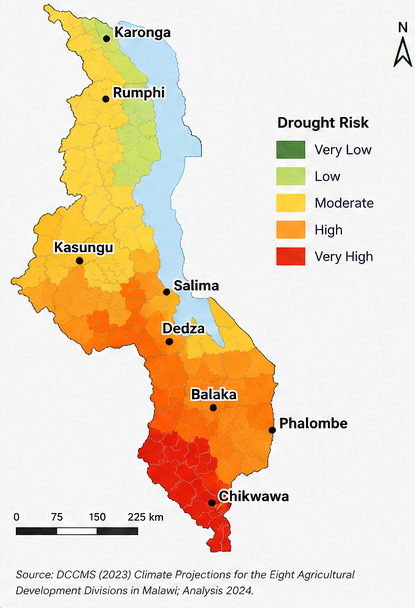
Likelihood of drought
The probability of drought occurrence. Helps identify districts that may require preparedness measures and strengthened early warning systems.
Impact of drought
The potential consequences of drought, reduced agricultural productivity, water scarcity, food insecurity, livelihood disruption and economic losses.
Risk of drought
The overall risk, combining likelihood and impact. Highlights priority areas for intervention, planning and resource allocation.
District-level drought profiles
Explore detailed likelihood, impact and risk maps for the most exposed districts.
Chikwawa District
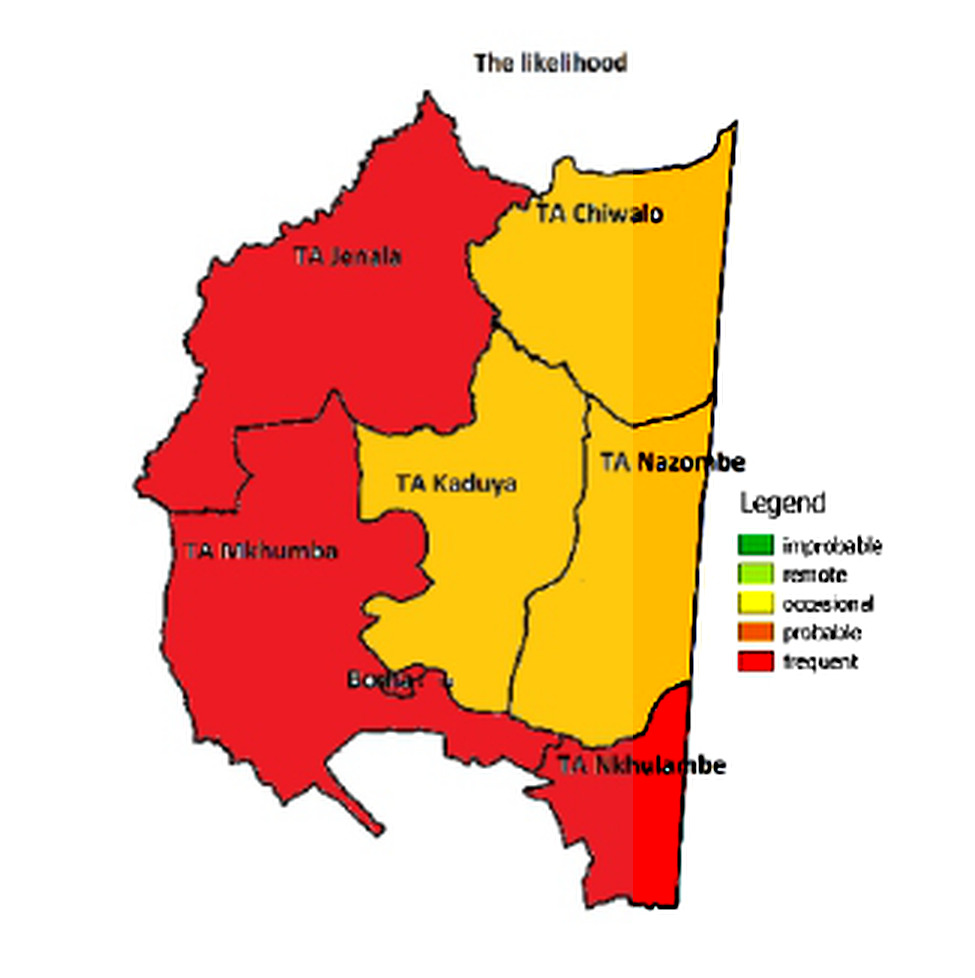
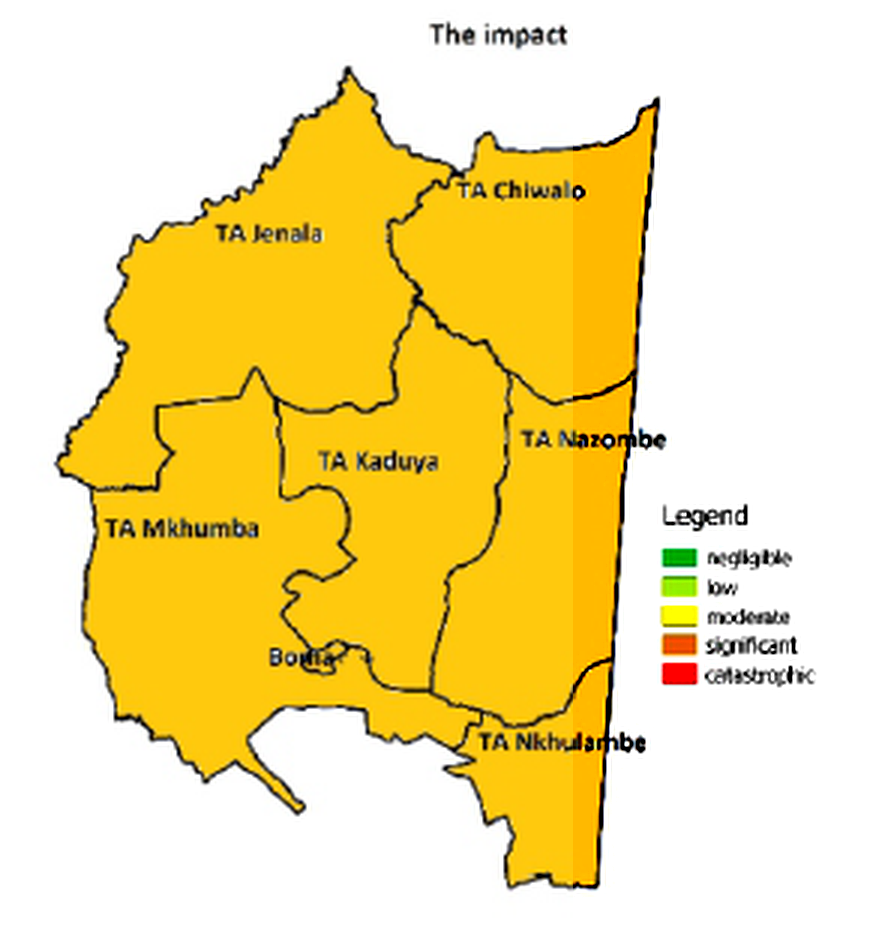
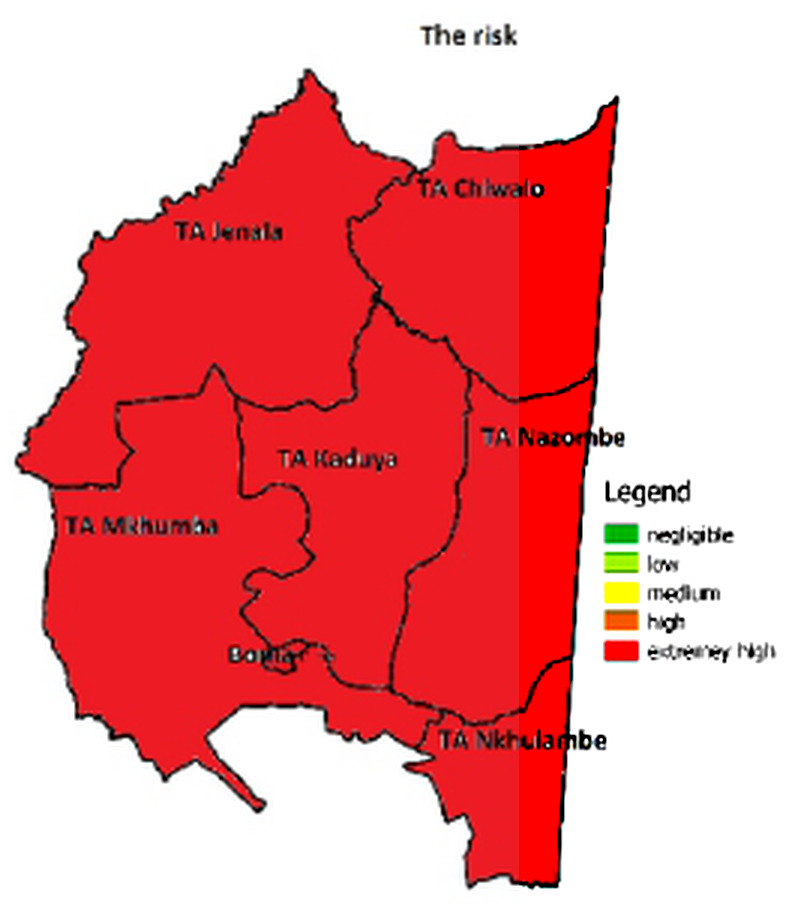
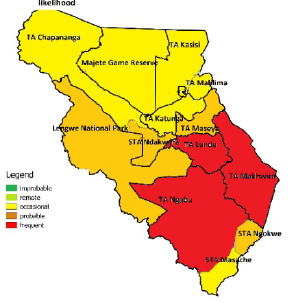
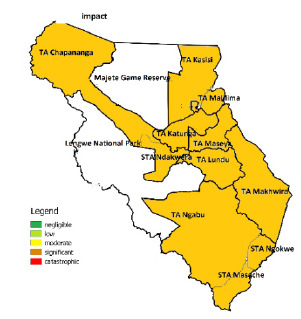
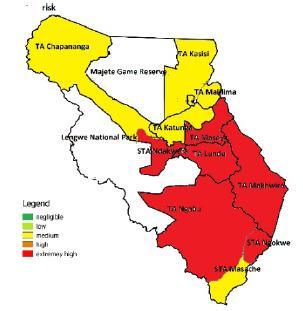
Chikwawa District presents a moderate to high drought vulnerability profile, with several Traditional Authorities (TAs) classified among the most exposed. The spatial distribution highlights clusters of high likelihood in specific TAs, while other areas remain moderately exposed.
- aFrequent drought occurrence in TA Lundu, Makhuwira and Ngabu, with probable occurrence in Lengwe National Park, STA Ndakwera, TA Maseya and STA Ngokwe, and occasional occurrence elsewhere, indicating heterogeneous exposure across the district.
- bConsistently significant impacts across all TAs, suggesting that drought events result in substantial and widespread consequences regardless of location.
- cExtremely high drought risk concentrated in key TAs (Maseya, Lundu, Makhuwira, Ngabu, Ngokwe and Ndakwera), while remaining areas experience moderate risk levels.
Implication for decision-makers: drought risk in Chikwawa is spatially differentiated, with high-risk clusters requiring targeted interventions in the most exposed TAs. The uniformly significant impacts also call for district-wide resilience measures, water resource management, climate-smart agriculture and early warning systems.
Phalombe District
Phalombe District faces a systemic and district-wide high drought vulnerability, with all areas classified as highly vulnerable. The spatial distribution shows higher drought likelihood in the western part of the district, consistent with observed dry-spell patterns.
- aModerate to frequent drought occurrence, with western and southern areas experiencing the highest exposure.
- bConsistently significant impacts across the entire district, indicating that all communities are affected regardless of location.
- cExtremely high overall drought risk, reflecting the combination of widespread exposure and strong impacts.
Implication for decision-makers: drought is a chronic and systemic risk requiring district-wide resilience strategies (water management, climate-smart agriculture), while prioritizing western areas as entry points for intervention.